
If you’ve spent any time exploring the wine shelves beyond the usual Cabernet and Pinot Noir, you may have stumbled across a bottle with a name that looks intimidating and tastes like a revelation: Blaufränkisch (say it with me — BLOW-FRAHN-kish). It’s the signature red grape of Austria, a cornerstone of Hungarian winemaking, and one of those grapes I keep coming back to precisely because so few American wine drinkers know it yet. Consider this your introduction to a grape that deserves a permanent spot in your rotation.

Blaufränkisch
A Grape with Many Names
Part of what makes Blaufränkisch tricky to track down is that it goes by a different alias almost everywhere it’s grown. The name itself translates roughly to “blue Frankish” — “blau” for the deep blue-black color of the grape skins, and “Fränkisch,” a term that in medieval Central Europe was used to distinguish “noble” varieties from lesser field blends.
Depending on which side of which border you’re standing on, you might see this grape called:
- * Kékfrankos in Hungary, Frankovka or Frankovka modrá in the Czech Republic and Slovakia
- * Modra frankinja in Slovenia, Frankovka in Croatia and Serbia
- * Burgund Mare in Romania
- * Lemberger (sometimes Blauer Limberger or Blue Limberger) in Germany and the United States, especially in the state of Washington
That last name is a nod to Lemberg, the old German name for the city of Lviv in present-day Ukraine, which once sat within the Austro-Hungarian Empire — a small reminder of just how far this grape’s story stretches across the old Habsburg map.
Where It Comes From
Blaufränkisch was first officially documented in 1862 at a Viennese viticultural exposition, but ampelographers are confident it’s been growing quietly across the region for far longer, likely since the Middle Ages. DNA profiling eventually settled a long-standing debate about its parentage: rather than being a clone of Gamay, as was once assumed, Blaufränkisch is actually the offspring of Gouais blanc (the same humble grape behind Chardonnay, Riesling, and dozens of other European varieties) and a little-known parent called Blaue Zimmettraube. That makes Blaufränkisch a half-sibling of Gamay, not its parent — genetic cousins rather than direct lineage.
Blaufränkisch has also done some parenting of its own. In 1922, it was crossed with St. Laurent to create Zweigelt, now Austria’s most widely planted red grape, and it also contributed to other Austrian crossings like Blauburger. In other words, if you enjoy a glass of Zweigelt, you already have Blaufränkisch to thank in part for it.
Home Turf: Austria’s Burgenland
While Blaufränkisch is grown across a swath of Central Europe, its true home and its finest expressions come from Burgenland, the Austrian wine region hugging the Hungarian border. A few sub-regions are worth knowing:
Mittelburgenland has embraced the grape so completely that it markets itself as “Blaufränkischland.” Here, Blaufränkisch produces structured, full-bodied wines with real cellaring potential. Leithaberg, with its limestone and mica-schist soils, is considered the source of some of the most elegant, mineral-driven examples, and the region has built its whole identity around this one variety. Südburgenland, and its Eisenberg district in particular, tends to produce a leaner, more peppery, high-acid style that pairs beautifully with food. You’ll also find respectable plantings in Carnuntum and eastern Niederösterreich (Lower Austria). All told, Blaufränkisch covers roughly 2,550 hectares in Austria, making up just under 6% of the country’s total vineyard area — a small footprint for a grape with this much personality.
Across the border, Kékfrankos is one of the most widely planted red grapes in Hungary, forming the backbone of many Egri Bikavér (“Bull’s Blood”) blends from the Eger region.
What to Expect in the Glass
Blaufränkisch is a grape that rewards patience, both in the vineyard and in the glass. It’s known to be a finicky variety, particularly susceptible to coulure (poor fruit set) during cool, wet flowering periods, which keeps yields modest and quality-focused growers on their toes.
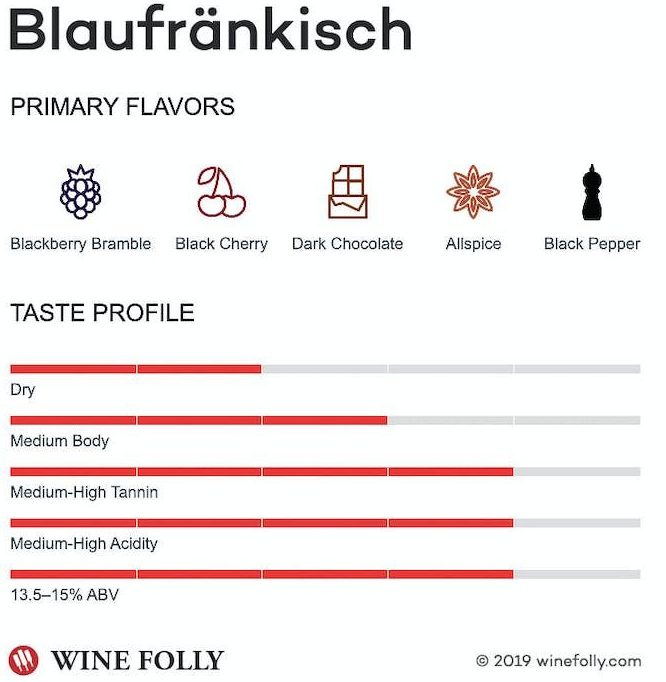
In the glass, look for a dark, inky color and aromas of black cherry, blackberry bramble, and wild berries, layered with baking spice, black pepper, and sometimes a whisper of dark chocolate. The wines are typically medium to full-bodied, with the kind of powerful acidity and firm, prominent tannin structure that can seem almost austere in youth. Give a bottle five to ten years, though, and those tannins soften into something velvety, while the fruit deepens into something more brooding and complex. Alcohol typically runs in the 13.5–15% range.
If you’re opening a young bottle, a 30-minute decant will do it a lot of favors. Serve it slightly cool for a red, around 60–68°F, to keep that peppery acidity lively.
On the Table
Blaufränkisch’s high acid and gripping tannins make it a natural at the dinner table rather than the cocktail hour. Its home cuisine offers the best clues: think smoked sausages and charcuterie, goulash built on red potatoes and sweet paprika, and cheesy spaetzle or dumplings that can stand up to the tannin. It’s also a lovely match for roast duck, mushroom-forward dishes, and hard, aged cheeses. If you’ve been reading along as I explore the “chillable reds” trend this year, a lighter-styled Eisenberg Blaufränkisch served with a slight chill is worth a try — it walks that line between structured red and refreshing pour better than almost anything else I’ve tasted.
Why Seek It Out
I keep returning to obscure grapes like Blaufränkisch because they tell you something true about a place — its soil, its history, its table. Blaufränkisch is Central Europe’s answer to Cabernet Franc or Syrah: structured, food-friendly, capable of real elegance, and still, for the moment, a relative bargain compared to its more famous counterparts. With import costs on many European wines shifting this year, a well-made bottle from Mittelburgenland or Leithaberg remains a genuinely smart pour for what you’re paying.
Next time you spot Blaufränkisch, Kékfrankos, or Lemberger on a shelf or a list, don’t hesitate. Pour it alongside something rich and savory, give it a few minutes to open up, and see for yourself why this grape has quietly held its ground in Central Europe for centuries.
 Previous Post
 Next Post