
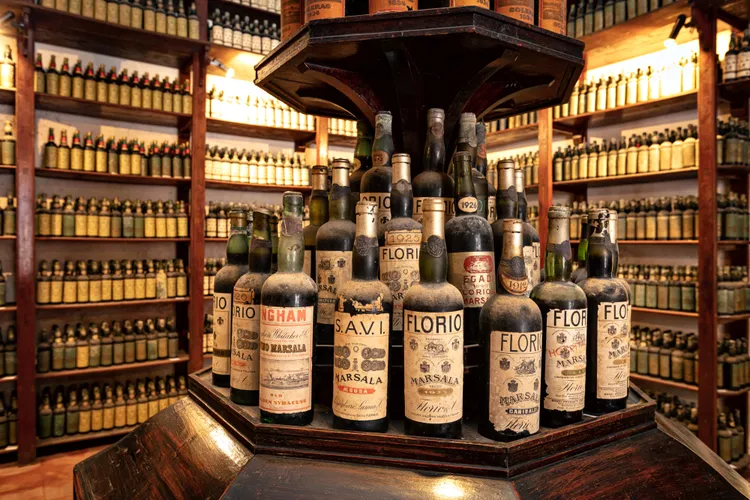
Marsala, the fortified wine from Sicily’s western tip, is known for its rich, nutty and slightly sweet flavor. It is well known as a cooking wine but is also a great sipping wine. It has undergone a quiet but significant revival in recent years, blending its storied heritage with modern innovation.

Marsala
The Wine’s History
According to WeLove Marsala, “It was 1773 when John Woodhouse, a young merchant from Liverpool, landed in Marsala and here like any good guest, he was welcomed with a glass of Perpetuo wine in a tavern in the city. Tradition has it that Woodhouse was headed to the port of Mazara, but due to bad weather, he was forced to divert the route towards Marsala, unaware that the wind was carrying him towards a new and unexpected commercial enterprise. Recognizing in that wine characteristics that shared it with Port, Sherry and Madeira, products of which the British market was already an excellent consumer, he saw in the marketing of Perpetuo a good business opportunity.”
ItalyAbroad tells us that Marsala is “one of the first wines in Italy to receive Denominazione di Origine Controllata (DOC) status, and the first in Sicily. Marsala holds a prestigious place in Italian wine heritage. While often mistakenly associated with cheap cooking wine, authentic Marsala is a sophisticated and diverse.”
From Decline to Rebirth
While this wine was shipped heavily in the 19th century, it lost favor in the the latter half of the 20th century. Today, a new generation of producers is repositioning it as a wine worthy of the modern table, focusing on quality, authenticity, and creativity.
A part of the rebirth is recognizing all the grapes that can be a part of this wine, which is named after the region, not a particular grape. You can use both white and red grapes to make the wine. Whites include Grillo (the most important and the one most contributing to the rebirth), Catarratto and Inzolia. Reds include Nero d’Avola, Nerello Mascalese and Pignatello.
This grape’s renaissance is focused on quality-driven production, grape-focused innovation, and cultural reconnection, ensuring Marsala’s place not just in history, but in the future of wine.
Production
Marsala is made using the in perpetuum (or solera-like) method, where a portion of the wine is removed each year and replaced with new must, creating a complex, layered profile. This process, similar to Sherry production, preserves the wine’s character over decades.
Types
From Food and Wine, we learn that this fortified Sicilian classic spans a range of dry to sweet styles, meant to be simmered, sipped, or savored. The wine is very food-friendly and rivals Sherry or Madeira in character and depth.
“Most American home cooks meet [the wine] in a skillet, splashed into a recipe, and then forgotten on the back of a pantry shelf. That narrow use has unfairly shaped the fortified wine’s reputation in the U.S., obscuring a category with centuries of history and a surprising range of styles. But it’s time Marsala had its moment.”
It’s the young, sweet wines that are used for cooking. But aged ones, meant not as ingredients but for slow, intentional drinking.”
Beyond these wines, you have:
• Superiore: aged for 2 years in barrels and with a minimum alcohol content of 18°
• Superiore Riserva: aged for 4 years in barrels and with a minimum alcohol content of 18°
• Vergine, “Soleras”: aged for 5 years in barrels and with a minimum alcohol content of 18°
• Vergine, “Soleras” stravecchio o Riserva: this is the best and rarest Marsala, and it is aged for 10 years.

Aged Marsalas
Sip: Surprising Food Pairing Capabilities
Dry and semidry styles, often labeled “Vergine” or “Superiore,” can be served slightly chilled as aperitifs or paired throughout a meal.
This wine goes great with many different dishes, including:
- Apple pie
- Bacon-wrapped water chestnuts
- Olives
- Chicken marsala
- Seafood
- Cheese and nutes
 Previous Post
 Next Post