
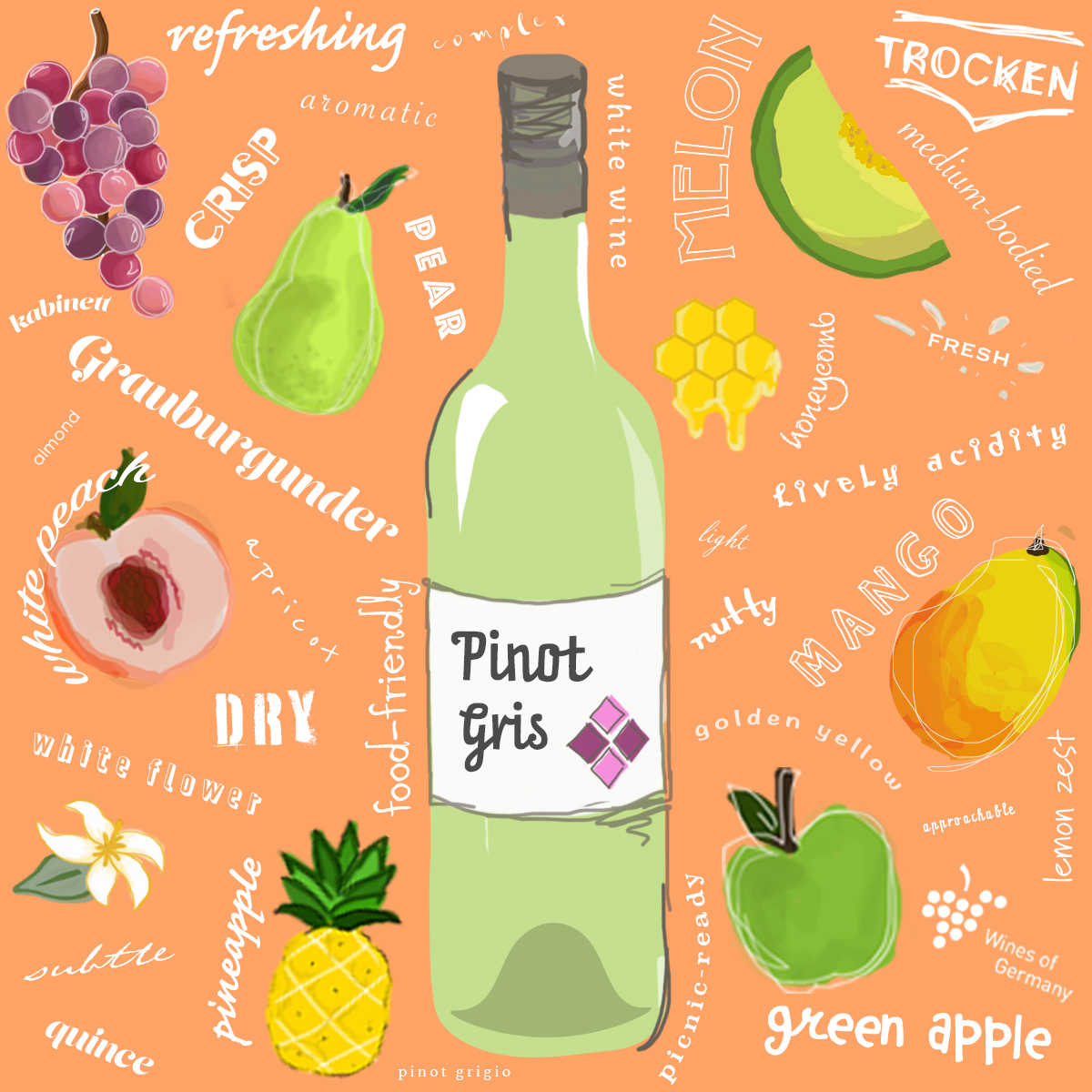
Grey Burgundy? A friend of mine is in Germany, and she just tried one and loved it. She said it’s actually Pinot Gris. I needed to do some research to learn more about this new name. Thank you to Austrian Wine and Wines of Germany for their help with this article.

Grey Burgundy
The Austrian/German Connection
According to Austrian Wine, “Pinot Gris was probably brought from Burgundy to Austria by Cistercian monks back in the 13th or 14th century – which is why the variety was once referred to as “Grauer Mönch” (grey monk). The grape made its way to Germany from Burgundy or the Champagne region and in 1711, it was found in a vineyard – which no longer exists – by the tradesman Johann Seger Ruland from Speyer (Palatinate). From here, the variety spread, referred to as ‘Ruländer’.”
The Name Grauburgunder
In addition to being called Ruländer, the grape is called Grauburgunder, which translates to Grey Burgundian.
Wines of Germany tells us that “The name hints at its relationship to Spätburgunder (Pinot Noir) – Pinot Gris is, in fact, a genetic mutation of the Pinot Noir grape. In French, grapes in the Pinot family get their name from the Latin root “pin,” meaning “pine,” as the grape clusters are shaped like pine cones, and ‘gris,’ meaning ‘grey,’ alludes to the grapes’ pinkish-gray skin color. While the German prefix ‘Grau’ also alludes to its skin color, the German name doesn’t reflect the grape’s shape but rather its origin in Burgundy.
“Though it’s the same grape, the German version stands out from its international counterparts. In comparison to French Pinot Gris and Italian Pinot Grigio, German Grauburgunder is usually more mineral-driven and has higher acidity. Grauburgunder’s floral aromas and citrusy flavors come through beautifully, and these wines are often tinged with exotic spice notes.”
Grauburgunder can also produce delicious sweet wines and zippy sparkling wines.
Food Pairings with Grey Burgundy
Enjoy this wine al fresco during picnics and gatherings along with:
- Seafood with heavy sauces, such as halibut with creamy sauce
- Colorful salads, such as apple, radish and fennel salad
- Steamed or grilled seafood, such as mussels or red fish
- Bold, hard cheeses, such as Gruyère
- Pasta and meat dishes, such as lamb meatballs
- Desserts made with honey, vanilla or marzipan
 Previous Post
 Next Post
Testing