
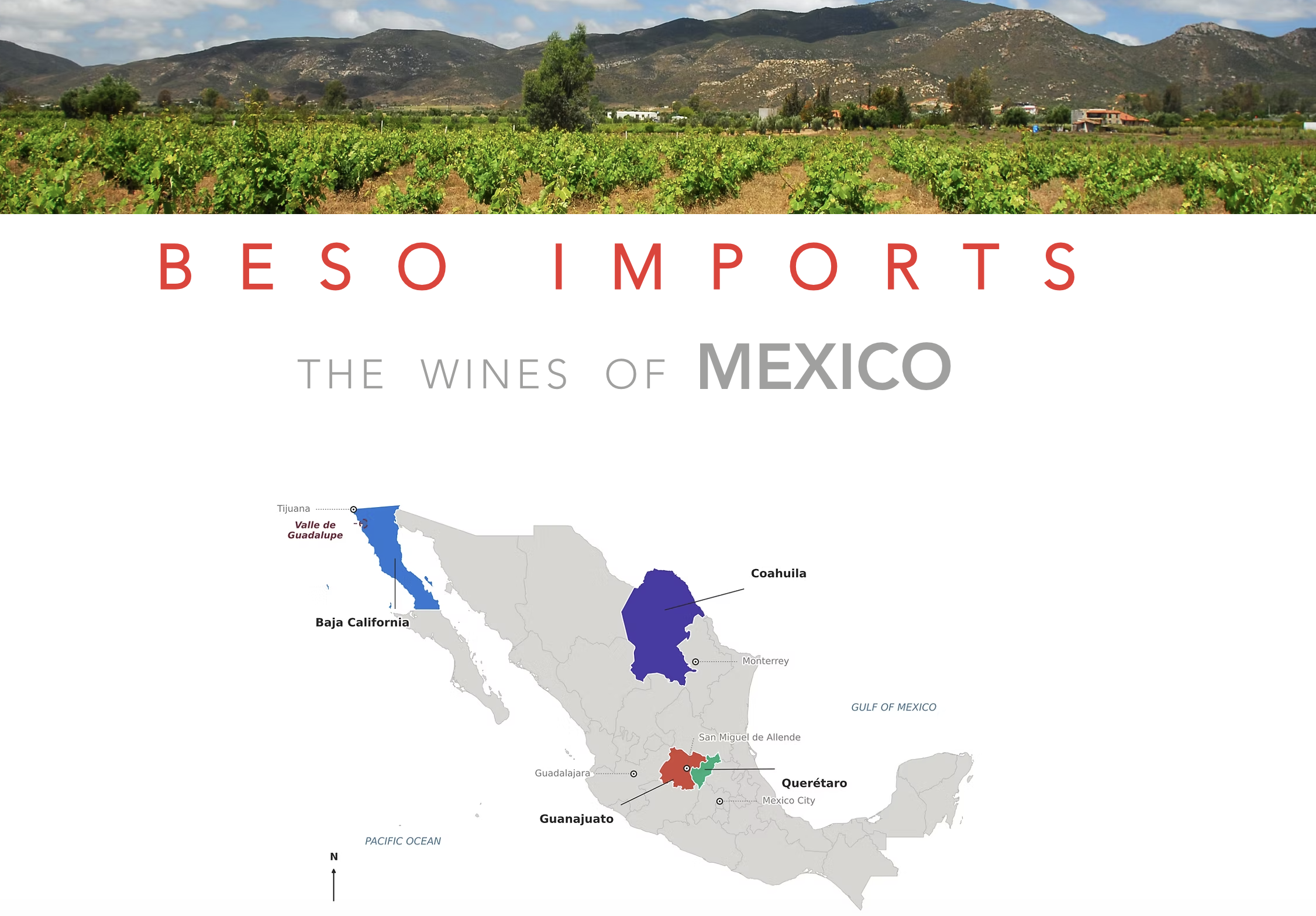
The other night, I attended a wonderfully fun CWES event where we learned about Baja California wines and wines from the surrounding northern Mexico area. What a treat that was. The speaker was Patrick Neri from Beso Imports. He was very knowledgeable. I’m excited to share what I learned with you. A lot of my content comes directly from Beso Imports’s website.

Beso Imports
It Started in the Early 1500s
The first grape plantings in the New World went into soil in 1521 in Valle de Parras in what is now the northern state of Coahuila in central Mexico. In fact, when the Spanish scaled up over the Sierra Madre Occidental mountains and first saw Parras Valley, they noted it was already full of grapevines (vitis Americana not vitis vinifera that they were soon to plant). Recognizing that the valley was obviously an ideal place for growing grapes, they planted vines and thus began the story of winemaking in the New World.
Today, 13 out of the 32 states in Mexico are planted with vines, and rich diversity of climates, soil profiles, grape varieties make it one of the most exciting wine regions in the world. Without the top-down imposition of a central bureaucracy telling the farmers which grapes they can grow or meddling in how they make their wines, the landscape of Mexican wineries is dominated by small production, estate grown munti-generational operations whose diversity is mind-boggling.
Casa Madero in Parras was started in 1597, and it is the oldest winery in the Americas!
The first vines were planted in Baja California in 1791, almost 200 years after grapes were first planted in Mexico.
The Whites and Pinks We Tasted
Our first wine was a wonderful 2025 Sauvignon Blanc called Viña Kristel from Monte Xanic, a Valle de Guadalupe winery in Baja California. The wine is “celebrated for its aromatic intensity, tropical and citrus notes, and elegant balance”. Monte Xanic, founded in 1988, is Mexico’s first boutique winery, known for sustainable, low‑intervention viticulture and hand‑harvesting at night to preserve freshness and acidity. (Beso Imports focuses on organic wines and other wines that are sustainably produced.)
Our next wine was a lovely 2024 blend (50/50) of Viognier and Marsanne. It’s name is Solar Fortun Aureo, and it’s made by Francisco Zarco Vineyard in Valle de Guadalupe.
We then had a 2025 Rosé wine made entirely from Mourvedre. Wow! I’ve never had a Mourvedre Rosé. It was delicious. For this wine, the grapes were harvested by hand at night to preserve maimum freshness. Clusters were destemmed and grapes sorted by hand before crushing. The intention was to make a very light, beautiful Provencal style Rosé. The juice was pulled away from the skins almost imediately to allow onlly a small amount of piment in the wine. Yum!

Mourvedre Rosé
The Reds We Tasted
We tasted four reds:
- – 2025 Dominio de las Abejas Nebbiolo from Valle de Ojas Negros Vineyard in Baja California
- – 2024 RG/MX Scielo Tinto – 40% Cabernet Sauvignon, 30% Merlot, 30% Syrah
- – 2022 Solar Fortun O Positivo – 60% Cabernet Sauvignon, 40% Syrah
- – 2022 Lomita Tinto de la Hacienda – 51% Cabernet Sauvignon, 29% Tempranillo, 20% Merlot
My favorite was the last one. Beautiful and smooth. They say that it drinks well now but will age nicely for 10 years. I only bought one bottle, so I don’t think I’ll be able to hold onto it for that long 🙂
If you are looking to purchase Beso’s wines online, please visit www.mexicanwine.us .
¡Salud!
 Previous Post